Overview
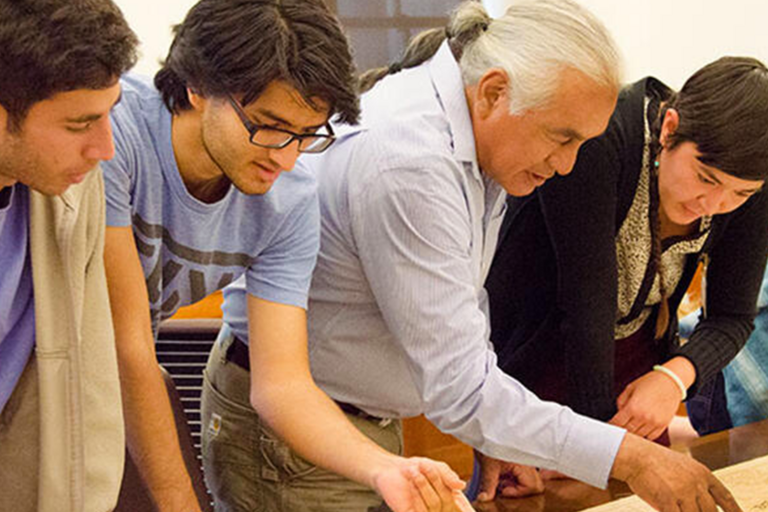
Launched in 2018, the UC Berkeley Creative Discovery Fellows Program (formerly Adobe Fellows) began as a collaboration between the American Cultures (AC) Center and the Academic Innovation Studio, with strong support from Digital Learning Services, Educational Technology Services, the Library, and Arts+Design. Since then, the program has evolved into a peer-centered model where students gain critical and creative support from Creative Discovery Fellows.
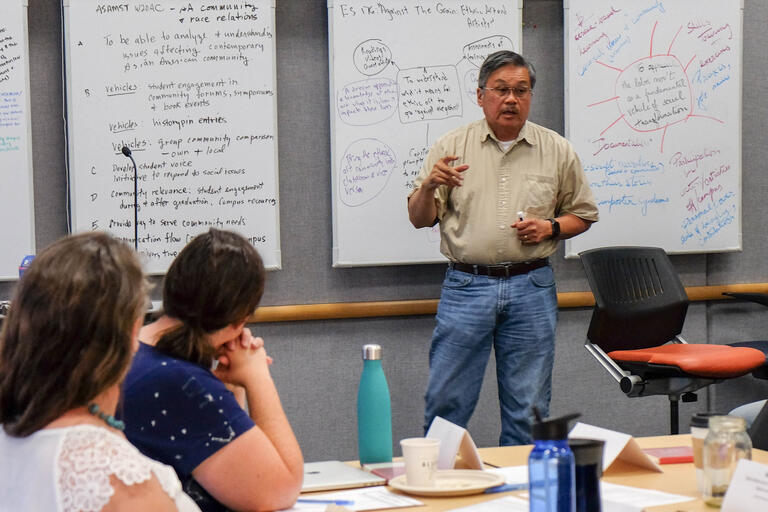
The Creative Discovery Fellows (CDF) Program helps instructors incorporate creative assignments into UC Berkeley’s undergraduate social justice graduation curriculum - the American Cultures (AC) requirement. The CDF program has been built to respond to a core question of anti-racism and social justice education: "How do we design supports for faculty and students in ways that are adaptive, equity-oriented, and foster anti-racism?" This question is fueled by the assertion that:
Anti-racist pedagogy is not about simply incorporating racial content into courses, curriculum, and discipline. It is also about how one teaches, even in courses where race is not the subject matter.
–Kyoko Kishimoto, Race, Ethnicity and Education v21 n4 2018:540
Incubated in the AC curriculum, where creative projects are central to "lifting" the analytical work of the classroom into broader circulation, the CDF program demonstrates that digital tools can be meaningfully integrated within anti-racism and social justice pedagogy.
The program has five main goals:
- To support faculty to develop course assignments that leverage creative tools to deepen and enhance student learning and critical thinking.
- To assist students, particularly from historically marginalized and underrepresented groups, to become ‘empowered producers and storytellers,’ actively shaping knowledge and acting as self-determined changemakers.
- To create a diverse set of cross-disciplinary practices, providing space for reflection and improvisation at the intersection of antiracism social justice pedagogy and digital tools.
- To research and understand conditions for equity-oriented student learning within the context of creativity and social justice.
- To make visible powerful, human, and more communal examples of instruction and learning.
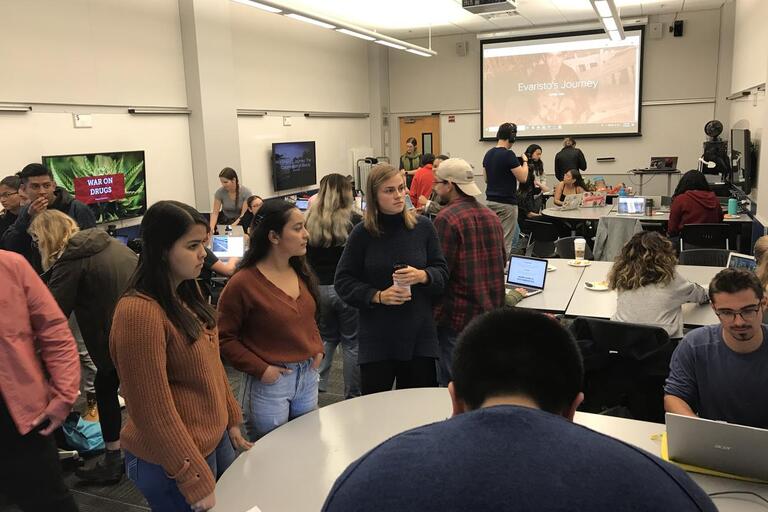
The program partners with faculty to implement these assignments, providing students with immediate technical and design support though The Creative Discovery Student Hub as well as in-class demonstrations, tutorials, and other resources to ensure that novices and experts alike are supported and encouraged to utilize the full range of their creativity.
We invite you to explore the rest of this website to learn more about the resources and impacts of the program.